Isokern Pumice Chimney Liner - All diameters 150mm to 600mm
Isokern Chimney Systems
Ex VAT £41.68Inc VAT £50.02

Isokern Chimney Systems

Isokern Chimney Systems


Isokern Chimney Systems

Isokern Chimney Systems

Isokern Chimney Systems

Isokern Chimney Systems
A Quick Guide to flue / liner diameters are as below. Please always consult your qualified installer to check suitability and requirements.
150mm (6") Diameter Flue Liners - Suitable for Class 2 Gas fires (125mm / 5") and wood burning stoves and smaller cassettes with a stove flue collar outlet of 5 or 6". Also possible is for use with balanced flue gas fires with an outer diameter of 150mm, this would normally still require a 4" Flexible Liner.
175mm (7") Diameter Flue Liners - Suitable for Class 1 & 2 Gas fires (5"-7") and wood burning stoves with a stove flue collar outlet of upto 7". Suitable for open flue gas fires, generally DFE types.
200mm (8") Diameter Flue Liners - Suitable for Class 1 & 2 Gas fires (5"-7"), Wood burning stoves and cassettes with a flue collar outlet of upto 8". Open Fires with an opening of maximum 550mm x 550mm, normally you would also need a concrete gather.
225mm (9") Diameter Flue Liners - Suitable for Class 1 & 2 Gas fires (5"-7"), Wood burning stoves with a stove flue collar outlet of upto 8". Open Fires with an opening of maximum 550mm x 550mm, normally you would also need a concrete gather.
250mm + (10"+) Diameter Flue Liners - Suitable for Open Gas Fires, generally a DFE basket in open fireplace, Wood burning stoves cassettes and fireboxes with a flue collar outlet of upto 10". Medium size Open Fires and you would also need to use concrete gather.
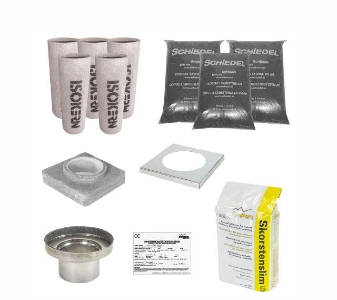
Here at Stovesaver we have created Isokern Liner Packs which include all items required for Standard builds and have easy add ons should you need an extra component or two to suit your project - Please see our Liner Packs Here
 Isokern Pumice Brochure Try the Isokern Liner Assistant Calculator
Buying single items lets you build a liner run that a standard pack does not cover: an odd height, a bend to clear a beam, a T liner for a freestanding stove, or a larger diameter for an open fire. The table below sets out the main Isokern liner components and the sizes Schiedel makes, so you can match each part to your chimney before ordering.
| Part | What it does | Sizes (Schiedel UK brochure) |
|---|---|---|
| Rebated pumice liner | The flue itself, laid socket uppermost and joined with lip glue | 15 diameters from 150mm to 1000mm. 600mm long up to 350mm, 1000mm long from 400mm |
| Bends (15°, 30°, 45°) | Offset the flue around an obstruction | 150mm to 350mm. Larger bends on request |
| T liners (45° and 90°) | Take a flue pipe in through the chimney wall for a freestanding stove | 45°: 150, 175 and 200mm. 90°: 150mm |
| Liner support block | The base of a liner run above a stove recess, for connecting the stove pipe | 150mm to 300mm, 75mm or 100mm high |
| Support plate | Spreads the load of the support block and liners onto the lintels | 4mm steel, sized to the support block |
| Stainless steel adaptor with sealing rope | Joins single wall stove pipe to a support block or T liner | 150mm to 300mm |
| Increaser adaptor | Steps up from a smaller stove outlet, for example 125mm to 150mm | 125–150mm up to 200–225mm |
| Access block and soot door | An opening for inspection and soot removal | 150mm and 200mm blocks. Double soot door 265 x 395mm |
| Lip glue | Seals and bonds every joint | 5kg bag |
| Light expanded clay aggregate | Insulating backfill between liners and masonry | 50 litre bag, about 19kg |
Stove in a recess: the support block sits on lintels with a support plate beneath, or on a cast concrete slab, bedded in a weak mortar mix. A stainless steel adaptor pushes up onto the support block spigot, sealed with fibre rope. Schiedel recommends at least 600mm of flue pipe before the connection. Freestanding stove: a T liner takes the flue pipe through the wall. The adaptor is fitted to the T liner and the pipe push-fits over it. Fit a soot door below the entry, seal the cavity with a wall sleeve, and keep any combustible insulation at least 1.5 times the pipe diameter away from the single wall pipe.
What is the difference between a support block and a T liner?
A support block starts the liner run above a stove in a recess, with the stove pipe coming up into it. A T liner is built into the run so that a freestanding stove's pipe can enter through the chimney wall from the side.
How many bends can an Isokern liner run have?
Schiedel allows a maximum of two complete offsets, which is four bends, per chimney, with no bend more than 45° from vertical.
Can I cut a pumice liner?
Yes, between bends to achieve an offset. Every cut joint must be fitted with a steel collar and sealed with lip glue.
How far must timber be from the liner?
Keep combustible materials 200mm from the inside surface of the liner or 40mm from the outside of the masonry chimney. Floorboards, skirting, dado and picture rails, mantel shelves and architraves are the exceptions.
Do I need a soot door?
For a freestanding stove connected through a T liner, yes. Schiedel requires a soot door below the flue pipe entry for inspection and removal of soot and debris.
Prefer a ready-made kit? See Isokern pumice liner packs, or use the Liner Calculator to pick the parts for your chimney.